
Je suis abonné au New-York in French, un Blog qui raconte les aventures des américains à la découverte des subtilités du Français.
En publiant cette charte du Tu et du Vous cet américain ne se doutait pas qu’il allait provoquer ce Buzz avec double traversée de l’atlantique. Entre le LA TIMES et LEMONDE pour être repris modestement par Guadeloupe Attitude !

The former French president Nicolas Sarkozy avoided using ‘vous’.
Photograph: Sean Gallup/Getty Images
Are Twitter and Facebook making the French less formal people, as Le Monde asked last week? Are we slowly giving up on the vous and calling everyone tu? Or, on the contrary, are social networks’ faux familiarity a reminder of the virtues of le vous and le tu? Probably a bit of both.
As a child of the 70s, part of the post-May 68 breed, I belong to a more informal French generation, the ones who only say vous to their elders and strangers, the ones who have had terrible difficulties adopting the Bonjour, Madame and Bonjour, Monsieur, always more at ease with Salut. When, as a child, I learned of how French aristocratic families (the few who escaped the guillotine) addressed each other, with children and parents saying vous to one another, I thought it was science-fiction. We were the salut generation, the ones with bad manners. Or so we thought.
Today, French people in their 20s hardly ever use vous or tend to think of it like the past perfect subjunctive, an archaic remnant. They have never known the world before the internet and social networks are their thing. They use textspeak, and communicate with emoticons. We had slang, verlan, and wrote love letters. They have got tweets, RTs and « likes ». They set up dates by text, and use Twitter to dump people. In a world where one communicates within the 140 characterlimit, vous is a hindrance and tu a godsend.
Things get complicated when different generations collide on the social networks. Last year, as the Le Monde blogpost points out, Franz Durupt, a young hack from the French daily dared to say « tu » to Laurent Joffrin, editor of Le Nouvel Observateur magazine on Twitter. Scandal. The older journalist complained and the Twittersphere accused him of being pedantic. He retorted that all he asked for was a little respect, and that the vous culture was exactly what social media needed most.
So, just who is being pedantic, and who’s being disrespectful?
The tu bunch often point to our Latin neighbours to advocate abandoning vous once and for all. However, arguing that as Italian and Spanish have long lost use of their formal pronouns French should do the same is slightly misleading. Usted and Lei in Italian are in fact much more formal than the French vous. Besides, there can be, as in Italian, a political background. I remember my Italian editor at L’Espresso who insisted I didn’t say vous to him as it reminded him of when Mussolini tried to impose an equivalent of the French vous on the Italian language (he wanted to use voi as a way to modernise the formal third person Lei). Words are a minefield.
I personally didn’t have a strong opinion on the matter until Nicolas Sarkozy came to power in 2007. The former French president said tu to everyone. This shocked and infuriated me as it did millions of French people. How dare he say tu to people he didn’t know? How disrespectful, how hypocritical, how disingenuous. I suddenly realised the importance of having two forms of address. Vous is not only a sign of respect and politeness towards an older person or a stranger; it puts a healthy and adult distance between two individuals, it gives them some space to actually get to know one another better, to win the other over and get to the stage where they’ll happily say « tu ». Tu is a sign of real intimacy, one that should be genuine, not contrived. Tu is a gift to real friendship – just not the kind you necessarily have with your 1500 Facebook « friends ».
BIENSÉANCE – Les règles du vouvoiement expliquées aux anglophones
Etes-vous un adulte ? Vous adressez-vous à un ami, à votre patron, ou à quelqu’un que vous ne connaissez pas ? A l’occasion de la fête nationale française, le quotidien californien Los Angeles Times a publié un graphique pour rappeler les règles du vouvoiement en français. La nuance reste délicate à saisir pour les anglophones, qui n’ont pas d’équivalent dans leur langue.
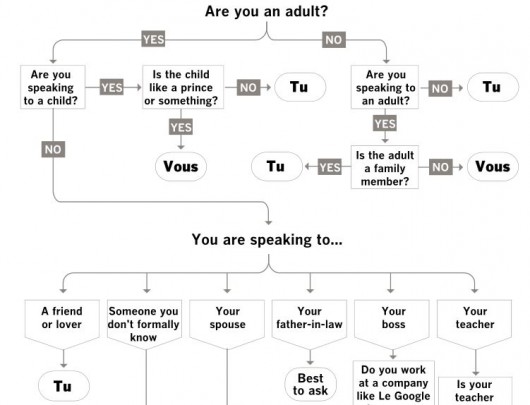
Infographie du Los Angeles Times sur le vouvoiement en français (source: LA Times)
La question se pose parfois même en France, où les réseaux sociaux font parfois sauter les convenances.
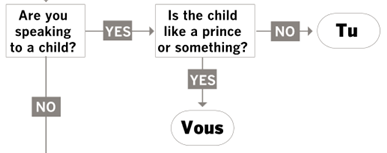
Le journal énonce des règles simples : si vous êtes un enfant et que vous vous adressez à un adulte membre de votre famille, il faut dire « tu », mais si vous êtes un adulte et que vous parlez à un enfant qui est « un prince ou quelque chose comme ça », le vouvoiement est requis.
Quelques subtilités régalent le LA Times : en français, on tutoie Dieu, tout comme son conjoint, sauf si celui-ci est Jacques Chirac et requiert le vouvoiement. Si vous ne travaillez pas dans une entreprise comme « le Google », tutoyer son patron n’est pas admis, à moins que vous ne souhaitiez lui signifier qu’il vous a passablement énervé.
La différence d’âge et les grands événements de société (« Avez-vous participé aux émeutes de mai 1968 réclamant une réforme gouvernementale et l’amour libre ? ») jouent un rôle non négligeable dans la propension à tutoyer, au risque de faire passer la forme de politesse pour un reliquat du passé, alors que la distinction tu/vous a tout de même son sens, défend une chroniqueuse du Guardian.
 Guadeloupe Attitude